Early Recognition
Why Early Recognition Matters
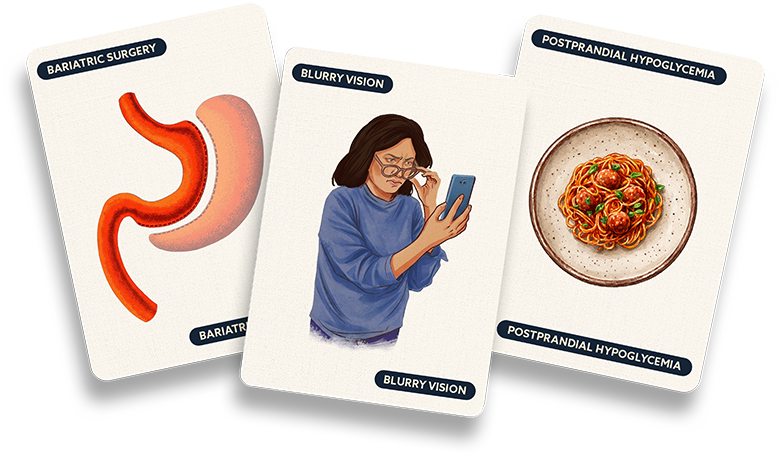
In PBH, diagnosis is often delayed, leaving some patients experiencing recurrent hypoglycemia for prolonged periods without structured support.1–3
Earlier recognition of PBH may present an opportunity to anticipate and manage cumulative clinical and safety risks over time.3

Jess,
person with PBH

Functional impact:1,4
Hypoglycemia can be associated with cognitive impairment, including effects on concentration and decision-making, which may have implications during daily activities, including driving, working, or caregiving.

Behavioral adaptation:1
Living with PBH can lead patients to develop compensatory behaviors as they try to manage the day-to-day impact of their symptoms. These may include restrictive eating patterns, or near-continuous intake of high-glycemic carbohydrates to self-treat episodes. Fear of episodes may also contribute to social withdrawal and reduced quality of life.

Long-term considerations:2,5
With recurrent hypoglycemia, some patients may develop hypoglycemia unawareness, characterized by reduced perception of typical warning symptoms and an increased risk of potentially life-threatening events, such as loss of consciousness or seizures and, in rare cases, death.

"It felt like my body was betraying me. I had episodes of confusion, dizziness, tremors, and mental fog that no one could explain. I even asked a psychologist if it could all be in my head."
— Person with PBH
Stepwise approach
A Stepwise Approach to Evaluating Suspected PBH
Evaluation of suspected PBH generally follows a stepwise clinical process:1,2
Screening For PBH
Clinical Features and Patient History
Because PBH symptoms are often non‑specific, screening relies on identifying patterns in the clinical history that may raise suspicion for PBH and help characterize symptom patterns, including:1,2

Symptom timing and onset:
The relationship between symptoms and meals (e.g., typically occurring 1–3 hours postprandially), whether symptoms occur during fasting or overnight periods, and when symptoms began relative to bariatric surgery.

Episode characteristics:
How frequently episodes occur, whether they are recurrent, and if symptoms include neuroglycopenic features.

Dietary triggers:
Specific foods or beverages, particularly high-glycemic carbohydrates, that may be associated with symptom onset.

Contextual factors:
Whether physical activity, stress, or other situational factors appear to influence the timing or occurrence of symptoms.
To support these discussions, published guidelines recommend a structured food and symptom log to document characteristics of symptoms and potential triggers over time.1,2
Resource: Diagnostic Checklist
Recognizing PBH can be challenging. This Diagnostic Checklist draws on published guidance to highlight the key considerations that may help you identify PBH in your patients.
DownloadWHIPPLE'S TRIAD
Bringing the Evidence Together: Whipple’s Triad
Once PBH is suspected, confirmation that symptoms are attributable to hypoglycemia is typically based on Whipple’s triad.6
Click each card to review the evidence:
Symptoms consistent with hypoglycemia1,5,6
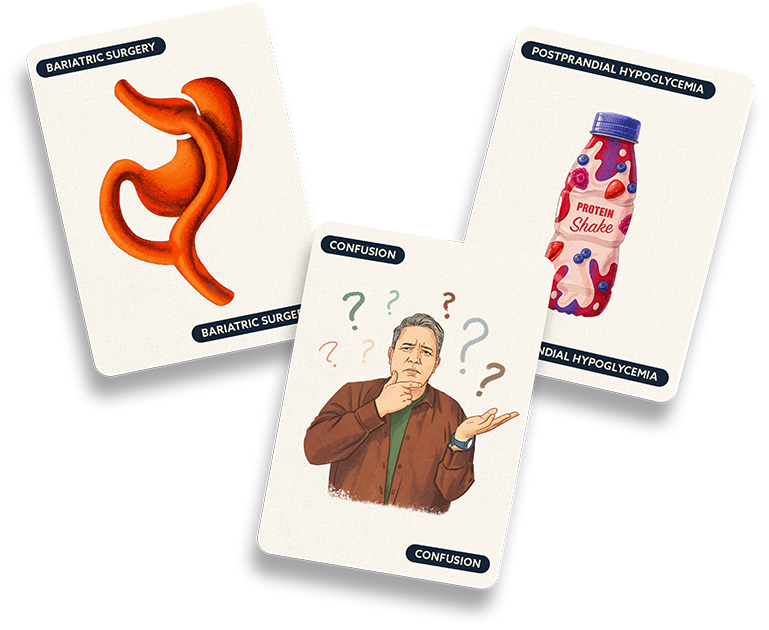
PBH episodes may involve autonomic and/or neuroglycopenic symptoms, that typically occur 1–3 hours postprandially (e.g., diaphoresis, tremors, confusion, fatigue).
PBH episodes may involve autonomic and/or neuroglycopenic symptoms, that typically occur 1–3 hours postprandially (e.g., diaphoresis, tremors, confusion, fatigue).
Low glucose levels documented during symptoms6
Biochemical confirmation of hypoglycemia involves documenting a blood glucose level <54 mg/dL, ideally measured from a venous blood sample using a laboratory method validated for low glucose concentrations. When venous sampling is impractical, capillary blood glucose measurement may be used as a pragmatic alternative for assessment.
Biochemical confirmation of hypoglycemia involves documenting a blood glucose level <54 mg/dL, ideally measured from a venous blood sample using a laboratory method validated for low glucose concentrations. When venous sampling is impractical, capillary blood glucose measurement may be used as a pragmatic alternative for assessment.
Symptom resolution following glucose correction6
Resolution after glucose correction supports hypoglycemia as the underlying cause.
Resolution after glucose correction supports hypoglycemia as the underlying cause.
Published guidelines do not recommend the use of an oral glucose tolerance test (OGTT) or mixed-meal tolerance test (MMTT) to diagnose PBH.6 Notably, OGTT carries a risk of provoking hypoglycemic seizures.3
Differential DIAGNOSES
Focusing on PBH: Key Differential Diagnoses
Once hypoglycemia is established, evaluating alternative causes can be an important next step in clarifying the underlying condition.1
Other causes of hypoglycemia to consider can include:1
- Insulinoma/proinsulinoma
- Malnutrition
- Hormone deficiencies (e.g., adrenal)
- Autoimmune hypoglycemia
- Non-islet cell tumors
- Medication side effects
PBH VS. Dumping syndrome
PBH vs. Dumping Syndrome
Dumping syndrome is often conflated with PBH because both can occur after bariatric surgery and may present with overlapping non-specific symptoms.1,2 Historical use of the term “late dumping syndrome” to describe PBH has reinforced this overlap, although the conditions differ in symptom timing and underlying pathophysiology.1,2
PBH1,2,5,7
Dumping Syndrome2,3,8–10
Pathophysiology
PBH1,2,5,7
A multifactorial condition in which altered gut-derived signals, abnormal insulin dynamics, and impaired counter-regulatory responses may combine to promote an exaggerated postprandial insulin response, leading to hypoglycemia.
Dumping Syndrome2,3,8–10
Rapid delivery of hyperosmolar contents into the small intestine leads to fluid shifts and neurohormonal responses.
Onset After Surgery
PBH1,2,5,7
A key characteristic of PBH is its delayed onset. Hypoglycemic episodes may develop months or even years after surgery.
Dumping Syndrome2,3,8–10
Dumping syndrome is an early postoperative complication that can develop weeks to months after surgery.
Symptom Timing
PBH1,2,5,7
~1–3 hours postprandially
Dumping Syndrome2,3,8–10
~15–60 minutes postprandially
Hypoglycemia
PBH1,2,5,7
Yes
Dumping Syndrome2,3,8–10
No
Symptoms
PBH1,2,5,7
Autonomic: Paresthesia, tremors, anxiety
Neuroglycopenic: Confusion, seizures, behavioral changes
Dumping Syndrome2,3,8–10
Vasomotor: Flushing, hypotension, tachycardia
Gastrointestinal: Abdominal pain/discomfort, bloating, diarrhea
Overlapping Symptoms
PBH1,2,5,7
Fatigue, weakness, palpitations, dizziness, syncope
Dumping Syndrome2,3,8–10
This table represents characteristic patterns of presentation. Individual patient features may vary.

“The doctor I found that listened to me and unlocked the mystery I’d been battling for months, gave me validation. I broke down crying that there was a name, a real reason I’d been so sick, that this was not in my head, this wasn’t something I made up.”
— Jennifer, person with PBH
1. Sheehan A, Patti ME. Hypoglycemia after upper gastrointestinal surgery: Clinical approach to assessment, diagnosis, and treatment. Diabetes Metab Syndr Obes. 2020;13:4469–4482. 2. Abdelgadir E, Rashid F, Awadi FA, et al. Post-bariatric hypoglycemia management: A Gulf Cooperation Council consensus statement. J Endocr Soc. 2025;10(2):bvaf225. 3. Lawler HM, McGinnis T, Patti ME. Diagnosis and management of post-bariatric hypoglycemia. J Am Board Fam Med. 2025;38(2):383–394. 4. Turk N, Ramanujan S, Shamloo T, et al. Continuous glucose monitoring in patients with postbariatric hypoglycemia: Effect on hypoglycemia and quality of life. J Endocr Soc. 2025;9(9):bvarf106. 5. Hölzen L, Schultes B, Meyhöfer S, et al. Hypoglycemia unawareness-a review on pathophysiology and clinical implications. Biomedicines. 2024;12(2):391. 6. Hazlehurst J, Khoo B, Lobato CB, et al. Society for Endocrinology guidelines for the diagnosis and management of post-bariatric hypoglycaemia. Endocr Connect. 2024;13(5):e230285. 7. Salehi M, Vella A, McLaughlin T, Patti ME. Hypoglycemia after gastric bypass surgery: Current concepts and controversies. J Clin Endocrinol Metab. 2018;103(8):2815–2826. 8. Masclee GMC, Masclee AAM. Dumping syndrome: Pragmatic treatment options and experimental approaches for improving clinical outcomes. Clin Exp Gastroenterol. 2023;16:197–211. 9. Cano R, Rodríguez D, Duran P, et al. Dumping syndrome after bariatric surgery: Advanced nutritional perspectives and integrated pharmacological management. Nutrients. 2025;17(19):3123. 10. Rogowitz E, Patti ME, Lawler H. Time to dump late dumping syndrome terminology. Obes Surg. 2019;29(9):2985–2986.