When to consider PBH
Clues That May Signal PBH
Despite clinically significant symptoms, PBH can be challenging to recognize. Its symptoms are often non-specific.1 Identification of characteristic clinical patterns may help differentiate PBH from other conditions.
CLUE 01

Relationship to bariatric surgery
01
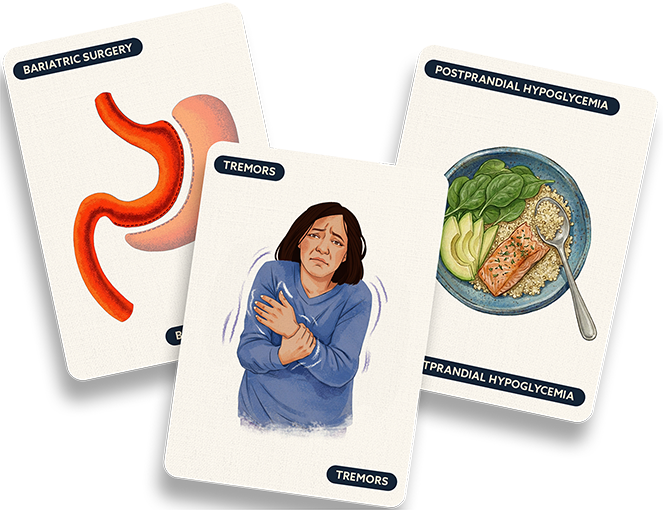
PBH is a chronic acquired form of hypoglycemia that develops after bariatric surgery1–4
A key characteristic of PBH is its delayed onset. Hypoglycemic episodes may develop months or even years after surgery, often after routine postoperative follow-up has concluded. This creates a window in which neither patients nor clinicians may readily connect recurring symptoms to the prior surgical procedure.
01
CLUE 02

Symptom profile
02
PBH presents with autonomic and/or neuroglycopenic symptoms1,2,5
Symptom severity may fluctuate across hypoglycemic episodes and can persist despite strict adherence to dietary and pharmacologic management. With recurrent hypoglycemia, some patients may develop hypoglycemia unawareness, characterized by reduced perception of typical warning symptoms and an increased risk of potentially life-threatening events.
02
CLUE 03

Symptom timing
03
PBH typically presents with postprandial hypoglycemia, most often 1–3 hours after meals1
While the timing window can extend beyond this range in some patients, fasting hypoglycemia is not a typical feature of PBH.
03
CLUE 04

Glycemic pattern
04
Hypoglycemia in PBH may recur multiple times within a single day, creating a characteristic pattern of fluctuating glucose levels1
Often described as a glycemic “roller coaster”, this pattern is characterized by postprandial glucose rises, followed by rapid declines, which may prompt patients to consume high-glycemic carbohydrates in an attempt to relieve symptoms, potentially perpetuating further glucose excursions.
04
CLUE 05

Triggers
05
PBH episodes are characteristically provoked by ingestion of high-glycemic carbohydrates, but other triggers have also been observed1,6
Additional reported triggers include physical activity, stress, alcohol, caffeine, and consumption of liquids with meals. Given the variability of triggers between individuals, maintaining a food and symptom log may support identification of patient-specific patterns.
05
Resource:Episode Tracker
A simple tracker to help patients record food intake, daily activities, and symptoms, supporting pattern recognition for discussion during appointments.
Download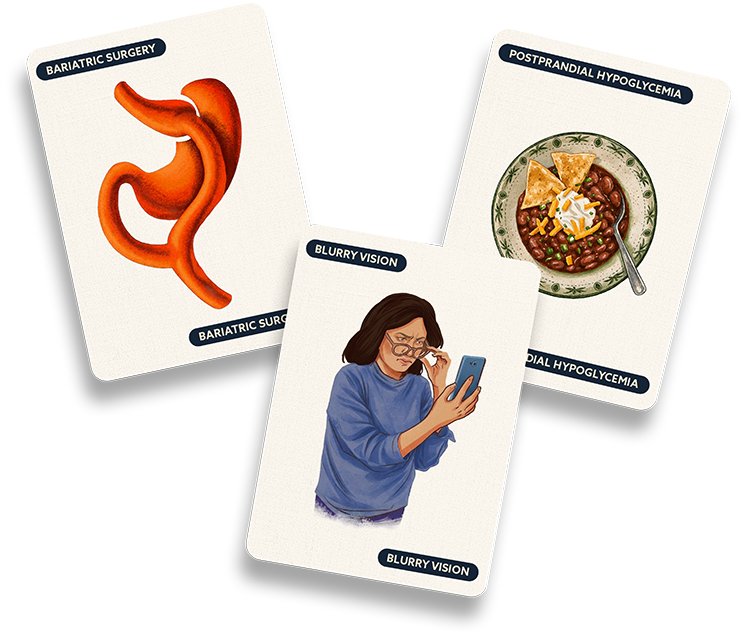

“There are times that I don’t even realize that I’m having an episode. I can feel perfectly fine, not a symptom at all, but something nagging me in my mind is telling me something is off. Other times I feel dizzy, my head feels like it’s in the clouds, I start to shake, and I will pass out.”
— Ashley, person with PBH
PBH Symptoms
PBH Symptoms
Although PBH symptoms are non-specific, they can be severe and unpredictable, affecting safety, cognitive function, and the ability to carry out everyday activities.1 Symptoms are broadly classified as autonomic or neuroglycopenic and typically emerge in a hierarchical pattern as blood glucose falls.2,3,5
Autonomic symptoms2,3,5

Diaphoresis

Tremor

Palpitations

Anxiety

Paresthesia
Neuroglycopenic symptoms2,3,5

Confusion

Fatigue

Weakness

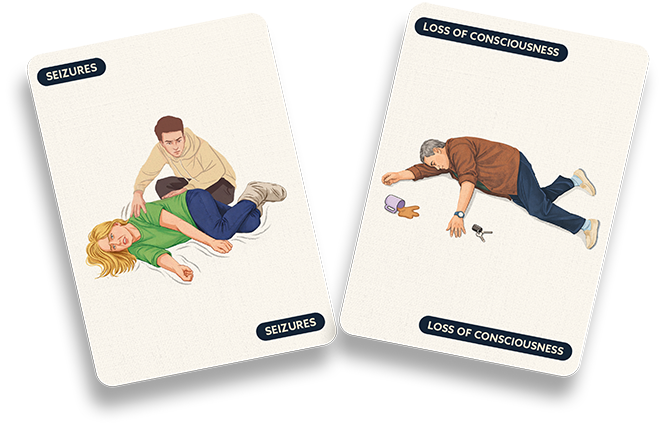
Seizures

Syncope
Hypoglycemia unawareness
Because PBH is a chronic condition and diagnosis is often delayed, patients may experience prolonged periods of recurrent, unmanaged hypoglycemia.1,2,6
Over time, this cumulative exposure can lead to hypoglycemia unawareness, a phenomenon characterized by impaired autonomic warning responses, and a reduced ability to perceive falling glucose levels.5,7 As a result, patients may first present with neuroglycopenic manifestations, such as confusion, loss of consciousness, or seizures, without preceding warning symptoms, significantly increasing safety risks.5,7
Therefore, earlier identification of PBH may present an opportunity to anticipate and manage cumulative clinical and safety risks over time.2
Risk Factors
Who May Be at Higher Risk of PBH? Trends That Support Suspicion
Current evidence regarding risk factors for PBH is inconsistent.1,3 In the absence of a clearly defined risk profile, careful history-taking and recognition of characteristic clinical patterns remain central to identifying patients who may warrant further evaluation.1
Potential risk factors include:1,6
- Female sex
- Younger age
- Absence of pre-surgery diabetes
- History of pre-surgery hypoglycemia
- History of cholecystectomy
- Roux-en-Y gastric bypass and sleeve gastrectomy
- Greater excess weight loss
PBH Prevalence
How Common Is PBH? Is There More to Be Uncovered?
The precise prevalence of PBH remains uncertain and estimates vary widely, largely reflecting differences in how cases are defined and identified in epidemiologic studies rather than uncertainty about the condition itself.1,3 What is clear, however, is that PBH remains underrecognized, with many individuals living with recurrent symptoms for years before diagnosis.2
~8%
Available data suggest that ~8% of patients in the U.S. who have undergone Roux-en-Y gastric bypass or sleeve gastrectomy over the last decade are currently living with PBH.8*
*Based on recent surgical cohorts (2013–2023) as a proxy for the current population.8,9
1. Sheehan A, Patti ME. Hypoglycemia after upper gastrointestinal surgery: Clinical approach to assessment, diagnosis, and treatment. Diabetes Metab Syndr Obes. 2020;13:4469–4482. 2. Lawler HM, McGinnis T, Patti M-E. Diagnosis and management of post-bariatric hypoglycemia. J Am Board Fam Med. 2025;38(2):383–394. 3. Hazlehurst J, Khoo B, Lobato CB, et al. Society for Endocrinology guidelines for the diagnosis and management of post-bariatric hypoglycemia. Endocr Connect. 2024;13(5):e230285. 4. Salehi M, Vella A, McLaughlin T, Patti ME. Hypoglycemia after gastric bypass surgery: Current concepts and controversies. J Clin Endocrinol Metab. 2018;103(8):2815–2826. 5. Hölzen L, Schultes B, Meyhöfer S, et al. Hypoglycemia unawareness-a review on pathophysiology and clinical implications. Biomedicines. 2024;12(2):391. 6. Abdelgadir E, Rashid F, Awadi FA, et al. Post-bariatric hypoglycemia management: A Gulf Cooperation Council consensus statement. J Endocr Soc. 2025;10(2):bvaf225. 7. American Diabetes Association Professional Practice Committee. Glycemic goals and hypoglycemia: Standards of care in Diabetes-2025. Diabetes Care. 2025;48(Suppl. 1):S128–S145. 8. Craig CM, Ramanujan S, McLaughlin TL. Prevalence of post-bariatric hypoglycemia in the United States. Surg Obes Relat Dis. 2026;22(6):674–683. 9. American Society for Metabolic and Bariatric Surgery. Estimate of bariatric surgery numbers, 2011-2023. Updated April 14, 2025. Accessed June 8, 2026. https://asmbs.org/resources/estimate-of-bariatric-surgery-numbers.